Home / News & Insights / Understanding Home Batteries: How They Actually Work
Before you compare battery quotes, it’s worth understanding what’s actually happening inside the box on your wall, and why sizing it correctly matters more than most people realise.
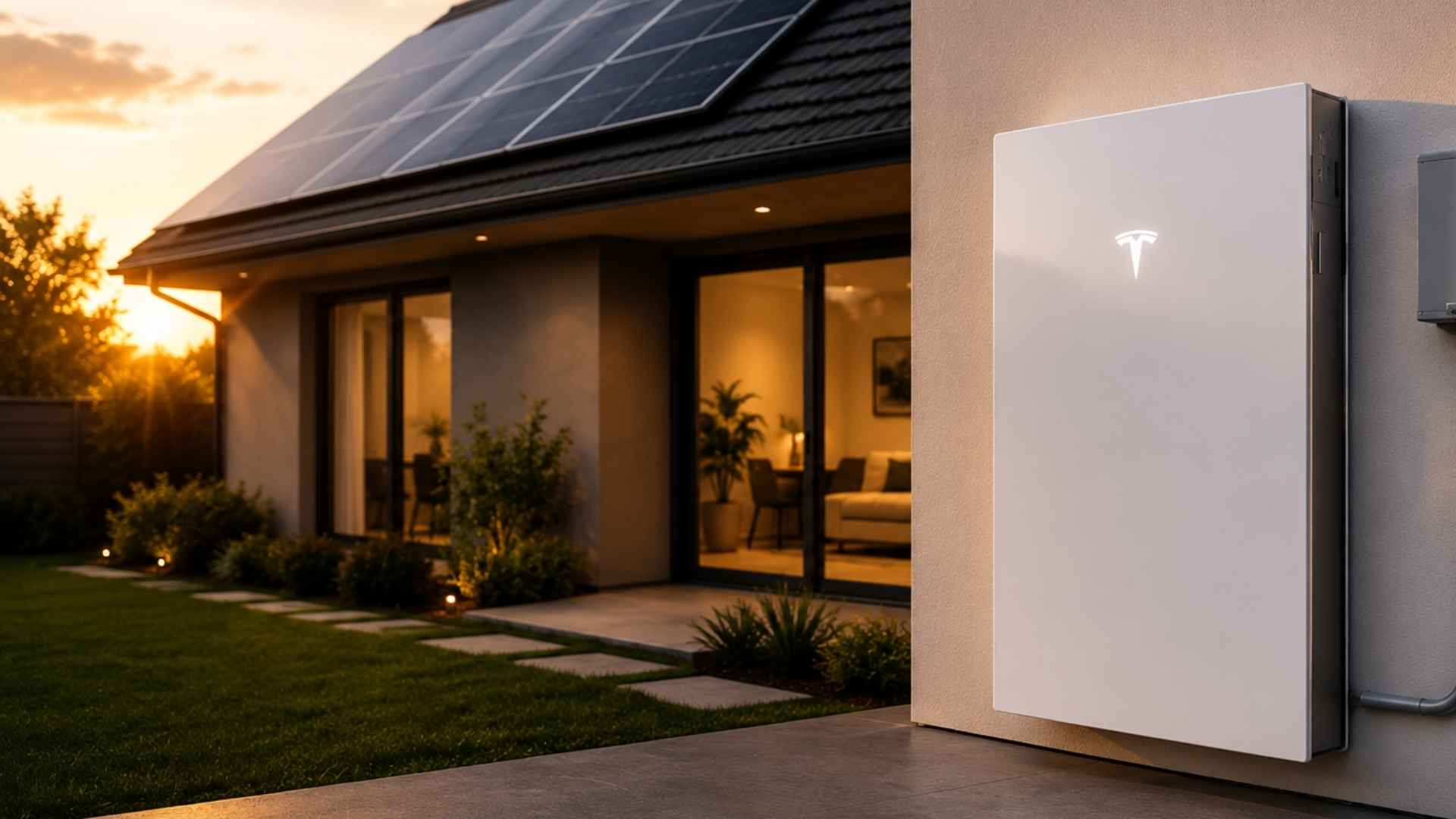
Without storage, any solar energy you don’t use during the day either gets exported to the grid for a fairly modest credit, or simply isn’t captured at all. A battery lets you shift that energy to the evening, when most households actually do a lot of their electricity use.
Many electricity retailers now charge significantly more per kWh during peak demand periods, typically late afternoon into early evening, and less overnight. A well-sized battery can carry a household through the expensive peak window entirely, then recharge later using cheaper off-peak grid power if needed, rather than paying peak rates for electricity you didn’t generate yourself.
Most (though not all) home batteries can keep some or all of your home’s circuits running during a blackout. This is a genuinely different value proposition to bill savings, and one some households weight more heavily than the financial return.
Joining a VPP effectively lends your battery’s spare capacity to the wider electricity grid at times it’s needed, in exchange for ongoing payments. It’s a bit like a bonus feed-in tariff for your battery rather than just your panels.
Not every household will value all four of these equally. For some, backup power during outages matters far more than the bill savings. For others, it’s purely about the numbers. Worth being clear on which of these matters most to you before you decide on size and features.
At a basic level, every rechargeable battery works the same way. Two electrodes (commonly referred to as the positive and negative terminals) are separated by a material that allows charged particles to move between them, but only in a controlled way.
When the battery discharges, that movement of charged particles is what produces a usable electrical current.
When you charge the battery, an external power source reverses that movement, effectively “resetting” it to store energy again.
Modern home batteries package this chemistry into individual cylindrical or flat cells, with a single home battery unit typically containing anywhere from dozens to thousands of these small cells wired together, depending on the design.
Just like with solar panels, batteries have two separate specifications that get confused constantly, and mixing them up is the single most common reason a battery ends up not doing what a homeowner expected.
A helpful way to think about it is to imagine a water tank with a pipe running out of it.
A battery can have plenty of stored energy but still not be able to power everything in your home simultaneously if its power output is too low.
Most residential batteries max out at around 5kW of continuous output. That’s enough for typical household demand, but potentially not enough if you’re trying to run something particularly power-hungry (a large ducted air conditioner, an electric sauna, or a big induction cooktop) at the same time as everything else.
If your home’s peak demand genuinely exceeds what a single battery can output, the options are generally a second battery, or accepting that some of that peak demand will still be drawn from the grid even with a battery installed.
When you’re comparing battery quotes, ask about both numbers, not just the headline storage capacity.
Until roughly a decade ago, home energy storage largely meant lead-acid batteries. They were heavy, bulky, required regular maintenance, and were typically only found in off-grid rural setups.
That’s changed dramatically.
Lithium-based batteries now dominate the residential market, for a straightforward set of reasons: better performance, no ongoing maintenance, longer warranties, and continually improving pricing.
Within lithium technology, there are two chemistries you’ll commonly encounter:
All home batteries sold in Australia are required to meet strict fire safety standards regardless of chemistry, but LFP’s inherent stability is a large part of why it’s become the go-to choice for new installations.
Emerging alternatives like sodium-ion batteries are being watched closely by the industry, but haven’t yet displaced lithium-based technology on performance or price.
Solar panels generate DC (direct current) electricity.
Your home runs on AC (alternating current).
Batteries store and release DC electricity.
Getting all of these to work together requires one of two approaches:
DC coupling uses a single “hybrid inverter” that manages both your solar panels and your battery in one unit.
It converts DC solar straight into DC to charge the battery, and separately converts DC (from either the panels or the battery) into the AC electricity your home actually uses.
This tends to be the more efficient option, since there are fewer conversion steps. It does mean your battery choice is tied to compatibility with that specific hybrid inverter, which matters most if you’re planning to add a different battery brand down the track.
AC coupling uses your existing standard solar inverter, plus a separate battery inverter that converts AC back into DC to charge the battery.
It’s slightly less efficient due to the extra conversion step, but it’s inverter-agnostic. Meaning an AC-coupled battery can generally be retrofitted to almost any existing solar system, regardless of what inverter you already have.
There’s a genuinely important local wrinkle with AC coupling worth knowing.
Your network distributor sets a maximum combined inverter capacity per phase for your connection (this is closely related to the export limits we cover in our guide on things nobody tells you before buying solar).
With AC coupling, your solar inverter’s capacity and your battery’s inverter capacity are often added together against that same limit. So a healthy-sized existing solar inverter can sometimes leave less headroom than you’d expect for adding a battery with its own inverter.
DC coupling avoids this issue entirely, since there’s only one inverter doing both jobs.
If you already have solar installed with a hybrid inverter, checking compatibility with your intended battery before buying can also mean skipping the cost of an additional battery inverter altogether. That’s a detail that’s easy to miss and can meaningfully change your all-in installed cost.
The core mechanism is straightforward.
A battery lets you charge up on your own “free” daytime solar generation, then draw down that stored energy overnight instead of buying electricity from the grid.
On a time-of-use plan, an appropriately sized solar-and-battery combination can let you avoid the most expensive peak-rate window almost entirely.
If you’re part of a VPP, there’s a further, ongoing income stream on top of your regular bill savings, though it’s worth going in with realistic expectations about how much that adds, since VPP payments vary and typically aren’t the main financial driver of a battery purchase on their own.
The catch, unsurprisingly, is cost.
A battery large enough to cover a household’s electricity use almost entirely is a genuinely significant investment, and the bigger your typical bill, the bigger (and more expensive) a battery would need to be to fully offset it.
This is exactly why sizing a battery to your actual household usage, rather than the biggest one a quote can fit, matters so much, and it’s a large part of why the federal rebate’s new tiered structure (covered in our dedicated battery rebate guide) now rewards right-sizing rather than maximum capacity.
A battery is a genuinely well-understood, mature piece of technology at this point, but getting real value from one depends on matching the right chemistry, the right power-and-energy sizing, and the right coupling method to your specific home and electricity habits, not just picking the biggest box available.
Combined with the current federal rebate and, for NSW households, the Home Energy Saver interest-free loan, the numbers on a correctly sized system are more compelling right now than they’ve been at almost any point before.
Book a free, on-site battery assessment with Sydney Solar and Roofing and we’ll work out the right chemistry, sizing, and coupling approach for your actual home, plus what it looks like once the current rebates are applied.